Residential Solar Installation in Dallas-Fort Worth
On This Page
ToggleNorth Texas Solar is a locally-owned residential solar installer serving homeowners across the Dallas-Fort Worth Metroplex since 2015. We design and install custom solar systems built around your home, your electric usage, and the realities of the Texas grid — not one-size-fits-all template installs from a national installer who’ll be hard to reach after the sale.
Whether you’re looking to lower your electric bill, add battery backup for grid outages, prepare your home for an EV, or move toward energy independence, we’ll put together a residential solar system sized for your goals. Request a free quote or call us at (940) 387-2716.
Why Choose North Texas Solar for Your Home?
DFW homeowners have plenty of solar companies to choose from — many of them national installers with rotating sales reps and no real Texas footprint. Here’s how we’re different:
Locally owned and operated since 2015. Founded in Fort Worth and run by Texans who actually live here. When you call us, you reach our team — not a national call center.
Full-time in-house installation crews. Our installers are our employees, on our crew, working on our jobs full-time. We don’t subcontract our primary installation labor like many large installers do.
Custom system design. Every home is different. We look at your electric usage, your roof orientation and shading, your panel configuration, and your goals — then design the system around what’s right for you, not what’s easiest for us to install.
25-year workmanship warranty. Our workmanship warranty covers our installation for 25 years, not the typical 5 or 10. We back what we install.
BBB-accredited, Tesla Certified Installer, and Good Contractors List member. Verified credentials with manufacturer relationships that benefit you — proper warranty preservation, direct manufacturer support, and a $25,000 third-party workmanship guarantee through Good Contractors List.
No high-pressure sales. Our consultations are educational. We’ll tell you when solar makes sense for your home and when it doesn’t. Read our customer reviews — the no-pressure approach is the most common theme.
Is Your Home a Good Fit for Solar?
Most DFW homes are good candidates for solar, but a few factors determine how good:
Roof orientation and shading. South-, west-, and east-facing roof spaces work well. North-facing slopes produce less energy. Heavy shading from large trees significantly reduces production — but partial shading can often be worked around with the right panel and inverter configuration.
Roof condition. Solar systems are designed for 25+ years of operation. If your roof has less than 10 years of life left, we typically recommend addressing the roof first or planning a removal-and-reinstallation when the time comes (a service we also handle).
Monthly electric bill. Solar makes the most financial sense for homes with $100+ monthly electric bills. The higher your usage, the more meaningful the savings.
Available roof space — or ground space. Most homes have enough roof for a system that offsets a meaningful portion of usage. Where roof space is limited, we can sometimes use a ground-mounted system or solar awning installed in the yard.
If you’re not sure whether your home qualifies, our free consultation includes a full assessment — we’ll look at your roof using satellite imagery, review your utility bills, and tell you straight whether solar is a fit for you.

How Solar Saves You Money in Texas
Texas homeowners save money with solar in three main ways:
Lower electric bills. When your panels produce energy your home uses, you’re not buying that energy from the utility. For a typical DFW home, this is the largest single source of savings over the system’s lifetime.
Protection against rate increases. Texas electricity rates have trended upward over the last decade. Solar locks in a portion of your power generation at the rate you paid for the system — insulation against future utility rate hikes.
Energy independence during outages. Paired with battery storage, your solar system keeps your home running through grid outages. After Winter Storm Uri and ongoing ERCOT reliability concerns, this isn’t a hypothetical benefit for Texas homeowners.
How much you save specifically depends on your system size, your electric usage, your utility rates, and the incentives you qualify for. We provide a detailed payback analysis with every quote so you can see real numbers for your home.
Solar Incentives Available in 2026
Texas homeowners have several incentives available, though the federal landscape has shifted significantly in 2026.
The Federal Solar Investment Tax Credit (ITC) — Important 2026 Update
The federal ITC has changed significantly. As of 2026, individual homeowners who purchase a solar system outright or through a conventional loan are no longer eligible to claim the ITC directly — the credit is now available to commercial buyers only.
However, homeowners can still access the financial benefit of the ITC through a pre-paid lease or Power Purchase Agreement (PPA), where the commercial owner of the system claims the credit and passes the savings on through lower rates. We work with trusted third-party financing partners to help homeowners structure these arrangements when it’s the right fit.
During your consultation, we’ll walk you through whether a PPA or pre-paid lease makes sense for your situation, or whether a cash purchase or conventional loan still pencils out without the federal credit.
Oncor Take A Load Off Texas Incentive
If you’re in Oncor’s service area — which covers most of DFW — you may qualify for the Take A Load Off Texas incentive for solar paired with battery storage. The incentive amount varies based on system size, production, panel orientation, and current program parameters. We handle the application as part of our installation service. Learn more about the Oncor Take A Load Off Texas program here.
Texas Property Tax Exemption
Texas exempts the added home value from solar installations from property taxes. Your home value increases when you add solar, but your property tax bill doesn’t go up because of it.
Other Utility Programs
Some Texas retail electric providers offer solar buyback plans where you’re credited for excess generation exported to the grid. The specifics vary by provider. We’ll discuss buyback considerations during your consultation. You can find all available incentives at https://dsireusa.org/
Our Custom Solar Design and Installation Process
From your first call through the day your system goes live:
1. Free consultation. A 15-30 minute conversation to understand your goals, your home, and your utility setup. We’ll ask about your roof, your monthly bill, and what you’re hoping solar will do for you.
2. Custom system design. We pull your utility usage history, assess your roof using satellite imagery (or visit if needed), and design a system sized for your home and goals. You’ll get a detailed proposal showing system sizing, expected production, expected incentives, financing options, and full pricing.
3. Site survey. Our team visits to verify roof condition, electrical panel capacity, panel layout options, and any structural or code considerations.
4. Permitting, HOA, and utility coordination. We handle the city permitting, HOA approval if needed, and the utility interconnection application. This is the slowest part of any solar project — but you don’t have to manage it. We do.
5. Installation. Most residential solar installs take one to three days on-site. Our full-time, in-house crews handle the work — no subcontracted primary labor.
6. Commissioning and monitoring setup. We test every part of the system, set up your monitoring app, walk you through how it works, and make sure you can see your production and home usage in real time.
7. Permission to Operate (PTO). Once your utility issues PTO, your system is officially live and producing. We stay your point of contact for the lifetime of the system — warranty service, monitoring questions, expansion planning if you want to add battery or EV charging later.
The Equipment We Install
We install high-quality solar equipment with strong manufacturer warranties.
Solar panels: Tier-1 monocrystalline panels from reputable manufacturers with 25-year performance warranties such as such as REC, Mission Solar, SEG, and many others.
Inverters: Microinverters (with one inverter per panel) for maximum production in partially-shaded conditions and the easiest troubleshooting, or string inverters for installs where they’re a better fit. We discuss the tradeoffs during your design phase. Our most popular options are Enphase, Tesla, Sol-Ark, and EG4.
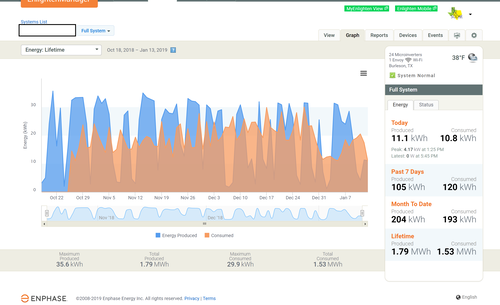
Monitoring: Real-time production and usage monitoring through manufacturer apps. You can see exactly what your panels are producing, what your home is using, and how your bill is affected — from your phone or computer, any time.
Mounting hardware: Stainless steel mounting hardware rated for Texas wind and weather conditions. Typically IronRidge, K2, or Unirac
Battery storage: We install a wide variety of Lithium back-up batteries such as Tesla Powerwall 3, Enphase IQ Battery, EG4, and others. Other battery chemistries are available, but far less common. Learn more about battery backup options.
Adding Battery Storage and EV Charging
Most of our residential solar projects include either battery storage or planning for future battery expansion. Reasons homeowners add storage:
- Grid outage protection — keep your home running when the grid goes down
- Time-of-use rate optimization — store solar production during the day and use it during peak-rate hours
- Off-grid capability — the more storage you have, the less you rely on the grid
We also handle home EV charger installation, which pairs naturally with solar and batteries — charging your EV with your own solar production is one of the most cost-effective ways to fuel an EV.
Warranty and Ongoing Support
Your residential solar system from North Texas Solar comes with:
- 25-year panel performance warranty from the manufacturer
- 25-year workmanship warranty from us on the installation itself
- 10-year inverter warranty (or longer depending on inverter selection)
- 10-year warranty on Tesla Powerwall or Enphase IQ Battery systems if included
- $25,000 workmanship guarantee through our Good Contractors List membership
We don’t disappear after install. If anything ever needs attention — warranty service, monitoring questions, panel cleaning, expansion planning — we’re the team you call.
Service Areas in Dallas-Fort Worth
We install residential solar across most of the Dallas-Fort Worth Metroplex. Specific city resources:
- Argyle Residential Solar
- Arlington Residential Solar
- Bowie Residential Solar
- Bridgeport Residential Solar
- Carrollton Residential Solar
- Celina Residential Solar
- Decatur Residential Solar
- Denton Residential Solar
- Fort Worth Residential Solar
- Frisco Residential Solar
- Justin Residential Solar
- Keller Residential Solar
Don’t see your city listed? We may still serve your area — most of DFW and surrounding cities are within our service range. Contact us to confirm.
Frequently Asked Questions
How much does residential solar cost in DFW?
The cost varies based on system size, equipment selection, battery storage, and your home’s electrical configuration. We provide detailed pricing in your free quote so you can see exactly what’s included. Most DFW residential solar systems range from $20,000 to $35,000 before any incentives.
How long does a residential solar installation take?
Most installations take one to three days on-site. The full process from signed contract to system live (PTO) is typically four to eight weeks — most of that time is permitting, HOA approval if needed, and utility interconnection.
Will solar work with my HOA?
Yes. Texas state law (Texas Property Code §202.010) prevents HOAs from prohibiting solar installations. HOAs can request reasonable aesthetic considerations, but they cannot block solar outright. We handle the HOA approval paperwork as part of our standard process.
Do I need battery backup with my solar?
You don’t need battery backup, but most of our DFW customers add it. Without battery storage, your solar system stops producing during grid outages (this is a safety requirement to protect utility line workers). Battery backup lets your home keep running through outages.
Can I add solar to my existing roof, or do I need a new roof first?
If your roof has less than 10 years of expected life left, we typically recommend replacing it first or planning ahead for a future removal-and-reinstallation. Solar panels are designed for 25+ years of operation, so it’s worth making sure the roof underneath can match that timeline.
How does the federal tax credit work in 2026?
The federal Investment Tax Credit (ITC) is now commercial-only for purchased solar systems. Individual homeowners can no longer claim the credit directly. However, homeowners financing through a pre-paid lease or Power Purchase Agreement (PPA) can still access the ITC’s value because the commercial owner of the system claims the credit and passes savings on through lower rates. We work with third-party financing partners to structure these arrangements.
How much does solar increase my home value?
Studies from Zillow and Lawrence Berkeley National Laboratory consistently show that homes with owned solar systems sell for more and often faster than comparable homes without solar. The exact boost depends on system size, age, and ownership — owned systems add the most value, while leased systems can complicate the sale.
Will my electric bill go to zero?
Probably not, but it depends on your system size relative to your usage. Most of our customers see their bills reduced significantly — often by 70-90% — though small base utility charges typically remain even with full offset. We design systems to maximize savings for your specific usage pattern.
What if I sell my house with solar on it?
Owned solar transfers with the home as a feature, increasing resale value. Our workmanship warranty is transferable to the new homeowner. Leased systems are more complicated — the new owner has to either assume the lease or you have to buy it out — which is one reason we generally recommend ownership over lease arrangements.
What’s the difference between residential and commercial solar?
Residential solar covers homes (single-family, townhomes, some multi-family). Commercial solar covers businesses, larger facilities, and grid-tied installations for commercial properties. We do both. The federal ITC changes mentioned above apply differently to commercial buyers, which is one reason commercial solar economics have shifted in 2026.
How do I get started?
Request a free quote online or call us at (940) 387-2716. The consultation is free, there’s no pressure, and you’ll come away with real numbers and a clear understanding of what solar would look like for your home.
Get a Free Residential Solar Quote
If you’re considering residential solar for your DFW home — or have questions about whether it’s right for you — we’d be glad to talk. The consultation is free, the assessment is thorough, and there’s no pressure. You’ll come away with real numbers for your home and a clear picture of what to expect.
Call us at (940) 387-2716 or request a free quote online.
We’re a locally-owned solar installer based in Fort Worth, serving homeowners across Dallas-Fort Worth since 2015.