Commercial Solar Installation in Dallas-Fort Worth
On This Page
ToggleNorth Texas Solar designs and installs commercial solar systems for businesses, schools, religious facilities, non-profits, and industrial properties across the Dallas-Fort Worth Metroplex. Since 2015, we’ve been helping Texas businesses convert a major operating expense — electricity — into a stable, predictable cost with meaningful tax advantages.
Whether you operate a single building, a multi-site portfolio, or a large industrial facility, we’ll design a commercial solar system sized for your usage, your roof or land, and your financial goals. Request a free commercial solar consultation or call us at (940) 387-2716.
Who We Serve
Commercial solar isn’t just for the biggest companies. We work with Texas businesses and organizations across a wide range of sizes and industries:
Standard businesses. Offices, retail spaces, restaurants, distribution centers, professional services firms, and any business operating from a building with usable roof space or ground area. If your monthly electric bill is meaningful, solar likely pencils out.
Industrial and warehouse facilities. Larger commercial properties with significant electric usage — manufacturing, warehousing, cold storage, processing facilities. These projects often have the strongest payback economics because the electrical demand is large and the available roof space is substantial.
Schools, universities, religious facilities, and non-profits. Institutional customers with specific funding considerations and longer planning horizons. These organizations benefit from solar’s predictable energy costs and from incentive programs designed for tax-exempt entities. We work with both private and public institutions across North Texas.
If your organization doesn’t fit cleanly into one of these categories but you’re interested in commercial solar, we’re glad to talk through whether it makes sense for your specific situation.
Why Commercial Solar Makes Financial Sense in Texas
Texas businesses install solar for several reasons that compound on each other:
Lower electric bills. When your panels produce power your operation uses, you’re not buying that power from the utility. For most Texas commercial customers, this is the single largest line-item savings.
Predictable, stable energy costs. Electricity is one of the most variable line items on a Texas business’s P&L. Solar fixes a large portion of that cost at the rate you paid for the system — for 25+ years. No more surprise rate increases, expiring contract rates, or unpredictable demand charges driving up your bill.
Demand charge management. Many commercial electric tariffs include demand charges that can represent 30-50% of your total bill. These charges are based on your single highest 15-minute usage spike during the billing period — even if that spike only happened once. Properly designed commercial solar can flatten your peak demand profile and meaningfully reduce demand charges. This is often where the biggest individual savings come from on larger commercial systems.
Federal Investment Tax Credit. Commercial buyers can claim a federal ITC equal to 30% of the system cost (more on this below), with potential bonus credits stacking on top. This is one of the most substantial business tax incentives currently available.
MACRS depreciation. Commercial solar systems are eligible for 5-year accelerated depreciation under MACRS, which dramatically improves the after-tax payback period.
Texas property tax exemption. Texas exempts the added property value from solar installations from property tax. Your property value increases when you add solar, but your property tax bill doesn’t.
Utility rebates. Many Texas utilities offer rebates and incentive programs specifically for commercial solar installations.
Sustainability and corporate image. Customers, employees, and partners increasingly care about a company’s environmental commitments. A visible solar installation supports that messaging in a way that’s verifiable, not just marketing copy.
Federal Investment Tax Credit (ITC) for Commercial Solar
The federal Investment Tax Credit is one of the most substantial tax benefits available to commercial solar buyers. Here’s the high-level overview:
Base credit: 30% of total system cost. Commercial buyers (including businesses, non-profits, schools, and other organizations) can claim a tax credit equal to 30% of the cost of the solar installation, including equipment, labor, and related costs. For most commercial projects under 1 MW — which covers virtually all standard business installations — the 30% applies automatically without additional labor requirements.
Bonus credit adders can stack on the base 30%:
- Domestic Content Bonus (+10%): For projects using solar equipment manufactured in the U.S. that meets specific domestic content thresholds.
- Energy Community Bonus (+10%): For projects located in designated “energy communities” — typically areas with historical fossil fuel industry presence or certain socioeconomic characteristics. Much of North Texas falls into one or more energy community designations.
- Low-Income Community Bonus (+10-20%): For projects in designated low-income communities or serving low-income households.
When bonus adders stack, the total tax credit can reach 40-50% or more of the project cost.
How the credit works:
The ITC is a credit against your federal business income tax liability — meaning it reduces what you owe rather than just deducting from taxable income. For most businesses, this is a dollar-for-dollar reduction in tax payable.
Important note: The federal solar tax credit structure is complex, with rules around qualifying projects, timing requirements, equipment sourcing, prevailing wage and apprenticeship requirements for larger projects, and how credits stack with other incentives. We provide an estimated ITC value for your project during your consultation, but the specific credit you can claim depends on your business’s tax situation. Always work with your CPA or tax advisor to confirm credit eligibility and timing for your specific project.
MACRS Depreciation for Commercial Solar
In addition to the federal ITC, commercial solar systems qualify for 5-year accelerated depreciation under MACRS (Modified Accelerated Cost Recovery System). This means your business can depreciate the cost of the solar installation over a 5-year period rather than the typical 25+ year service life of the equipment.
The depreciation works alongside the ITC — you reduce the depreciable basis by half the ITC value (per IRS rules), then depreciate the remaining basis over 5 years using accelerated schedules. The combined tax benefit of the ITC plus accelerated depreciation can recover a substantial portion of the project cost in the first few years.
The combined math is significant. For a typical commercial solar project:
- Federal ITC reduces your tax liability by 30%+ of the project cost in year one
- MACRS accelerated depreciation provides additional tax deductions over the following 5 years
- Property tax exemption and utility rebates further reduce out-of-pocket costs
- Energy bill savings then continue for 25+ years
This is the math that makes commercial solar work for so many Texas businesses. As always, work with your CPA to model the specific tax benefits for your business — we provide the project economics, your CPA confirms how they apply to your tax situation.
Utility Rebates and Local Incentives
Beyond federal tax benefits, several Texas utilities offer commercial solar incentive programs:
Oncor commercial solar programs. Oncor offers commercial solar and battery storage incentives through programs that change year to year. We work with these programs regularly and can identify what’s available for your project.
Denton Municipal Electric, CoServ, and other utilities. Different utilities serving the DFW area have their own incentive programs and rebates for commercial solar. We work with multiple utilities across the region and can identify applicable programs.
Texas property tax exemption. Texas Tax Code Section 11.27 exempts the added home or business value from solar installations from property tax. Your property assessment for tax purposes doesn’t increase because of the solar system.
We’ll evaluate all applicable incentives for your specific location and project during your consultation and include them in your project economics.
A federal tax credit of 30% and numerous utility company rebates from utilities such as Oncor, Denton Municipal Electric, Coserv, and others. The credit remains at 30% of the cost of installing solar energy systems until 2033, where the credit will reduce to 26%. It’s important to act before 2033 if you want to maximize the 30% tax credit.
Commercial Solar System Types
We design and install several configurations depending on your facility:
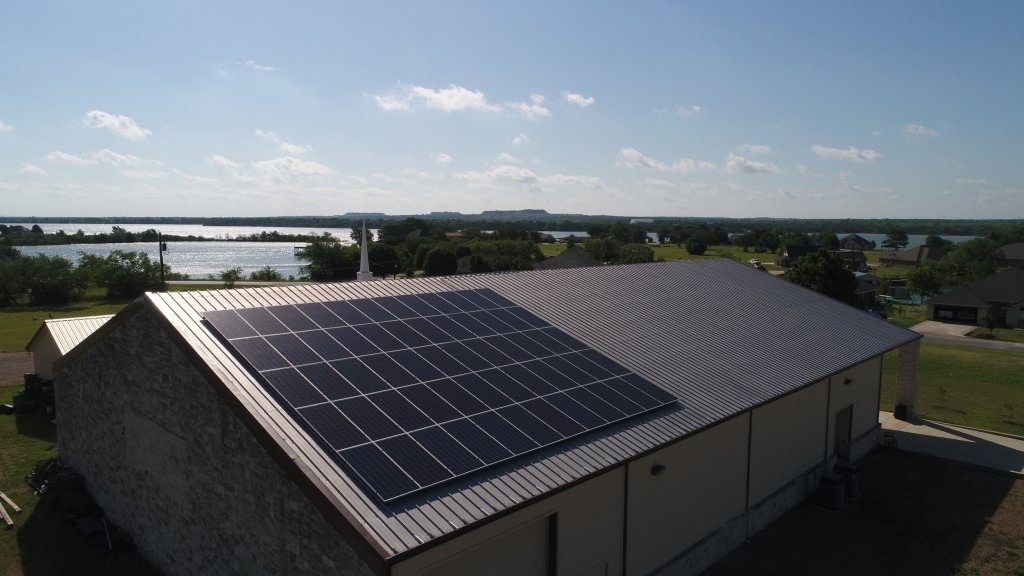
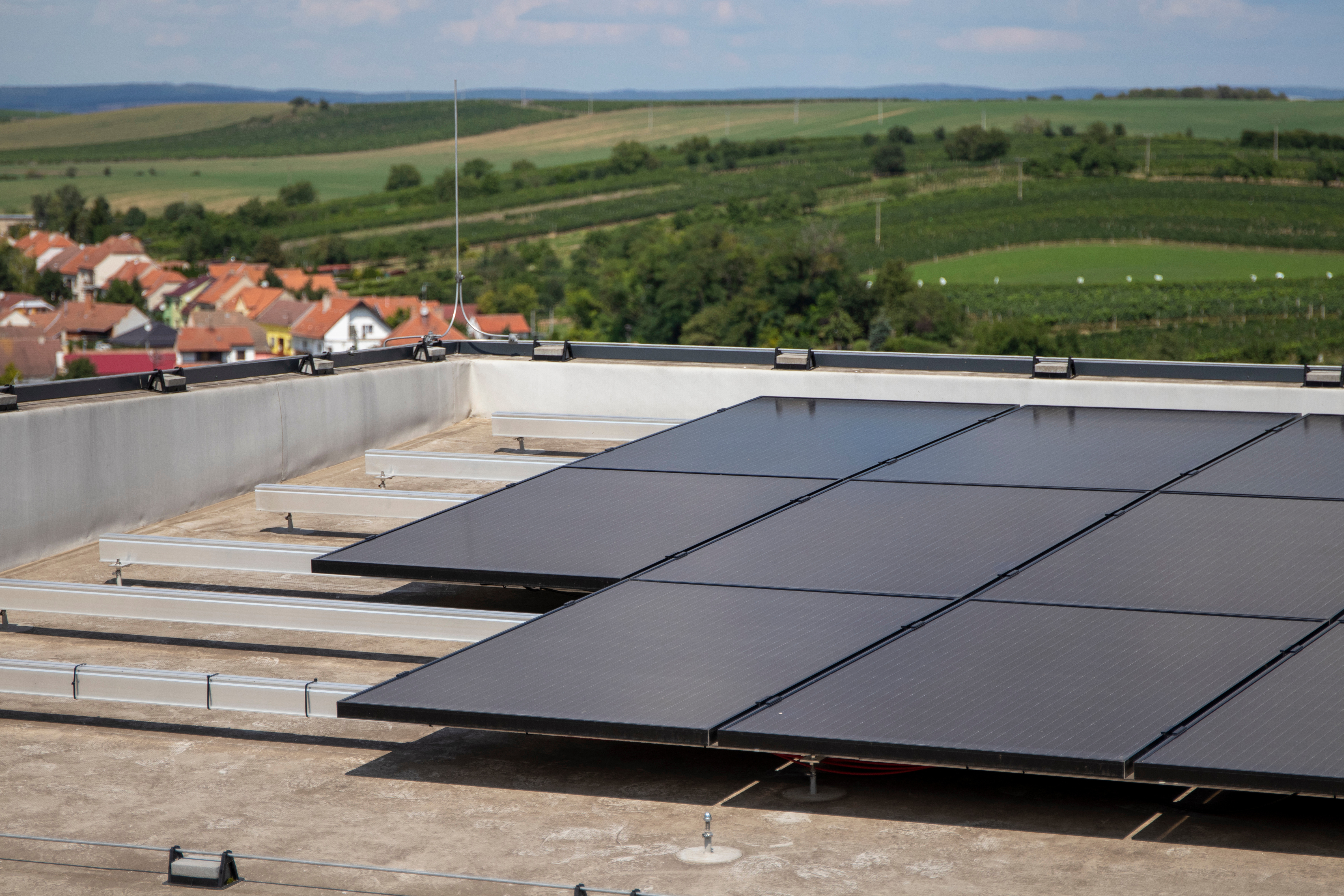
Roof-mounted systems. Most common for businesses with sufficient roof area. We assess roof structural capacity, available unshaded area, roof age and condition, and any required reinforcement before designing the array.
Ground-mounted systems. For properties with available land — common on industrial sites, schools with surrounding grounds, religious facilities with parking or unused acreage, and non-profits with land assets. Ground-mounted systems can often be larger than what a roof would accommodate.
Solar carports and canopies. Solar panels mounted over parking areas — generating power while providing shaded parking for employees and customers. Particularly valuable for businesses, schools, and religious facilities where parking is plentiful but unused otherwise. We can also integrate EV charging into solar carport designs.
Larger ground-mount and utility-scale projects. For organizations with substantial land assets and high electrical demand, we design larger ground-mounted solar installations. These projects involve more complex permitting, interconnection coordination, and design work, but the economics for the right property can be excellent.
Our Commercial Solar Process
From initial contact through commissioning:
Initial consultation
A conversation to understand your facility, your electrical usage, your goals, and your decision timeline. Commercial projects typically have multiple stakeholders — we’re glad to coordinate with your CFO, facilities manager, and any board approval requirements.
Energy audit and feasibility analysis
We pull your utility usage history (typically 12-24 months), assess your roof or ground space, evaluate electrical infrastructure, and model what a system would produce.
Custom system design and proposal
You receive a detailed proposal including system specifications, expected production, full project economics (incentives, ITC, MACRS, payback period, ROI), financing options, and timeline.
Engineering, permitting, and interconnection
We handle structural engineering reviews, electrical engineering, city and county permits, and utility interconnection applications. Commercial permitting is more involved than residential — we have experience with the various DFW jurisdictions.
Installation
Our crews handle the install. Commercial timelines vary based on system size and complexity, but typical projects run 2-6 weeks of on-site work.
Commissioning and verification
Full system testing, monitoring setup, utility coordination for permission to operate, and documentation for your records and warranty.
Ongoing support
Monitoring access, warranty service, performance verification, and expansion planning as your business grows.
Service Areas
We provide commercial solar installation across the Dallas-Fort Worth Metroplex and the surrounding region, including:
Fort Worth, Dallas, Denton, Arlington, Plano, Frisco, McKinney, Carrollton, Richardson, Garland, Mansfield, Keller, Southlake, Grapevine, Lewisville, Irving, Allen, and surrounding cities. We also work with rural and ranch commercial properties across North Texas. Contact us to confirm we can serve your location.
Frequently Asked Questions
Commercial solar pricing varies widely based on system size, site complexity, equipment selection, and what’s included. After incentives and tax benefits, most commercial projects pay back within 5-8 years, with 17-20+ years of continued energy savings thereafter. We provide detailed pricing and full project economics in your free quote.
On-site installation varies based on system size — typically 2-6 weeks for medium commercial projects, longer for very large or complex installations. The full timeline from signed contract to commissioning includes engineering, permitting, interconnection, and procurement — typically 12-24 weeks total depending on project size and current permitting volumes.
Most for-profit businesses can claim the federal ITC against business income tax liability. Non-profit and tax-exempt organizations have different mechanisms (such as direct pay or transferability) that can effectively provide the same benefit. Your CPA can confirm what applies to your specific business structure.
The ITC is a tax credit (direct reduction of tax owed) equal to 30%+ of the system cost. MACRS depreciation is a tax deduction (reduction of taxable income) that allows you to write off the equipment’s cost over 5 years. They stack — businesses typically get both, dramatically improving the after-tax economics.
Non-profit and tax-exempt entities can still benefit from the federal ITC through provisions in current tax law that allow direct pay or transferability of the credit. These mechanisms are newer and somewhat complex — we work with non-profit clients and their tax advisors to navigate them.
Yes, for most commercial customers. Demand charges are based on peak usage during the billing period, and a properly designed solar system can flatten that peak. We model your demand profile during the design phase and size the system accordingly. For businesses with heavy demand charges, this is often where the biggest savings come from.
Yes. Commercial solar systems require ongoing performance monitoring and periodic service. We offer ongoing maintenance contracts for systems we install and can also service commercial systems installed by other companies.
Yes. Commercial battery storage is increasingly common — for demand charge reduction, time-of-use rate arbitrage, and backup power during grid outages. We design solar-plus-storage systems for commercial customers, and battery storage retains favorable tax treatment that extends beyond solar’s deadlines.
Solar-integrated EV charging is one of our specialties. A solar carport with EV chargers creates a parking amenity, generates power for the building, and supports EV adoption among employees and customers. Learn more about our EV charging services.
Request a free commercial solar consultation or call us at (940) 387-2716. We’ll start with a phone conversation, then move to a site assessment and detailed project proposal.
Get a Commercial Solar Quote
If your business, school, religious organization, non-profit, or industrial facility is considering solar, we’d be glad to put together a detailed project analysis. The consultation is free, the proposal is detailed, and you’ll come away with real numbers you can model against your operating costs.
Call us at (940) 387-2716 or request a free consultation online.
We’re a locally-owned solar installer based in Fort Worth, serving Dallas-Fort Worth businesses since 2015. BBB-accredited, Tesla Certified Installer, Good Contractors List member, and trusted by Texas businesses for sensitive solar work.