Off-Grid Solar Installation in Texas
North Texas Solar designs and installs fully off-grid solar systems across Texas — for ranches, custom new home builds, remote properties, and hunting and recreational properties where utility power either isn’t available or isn’t worth the cost. We’ve been doing this since 2015, and going fully off-grid is one of our specialties.
If you’re building on a rural property, working a ranch, putting up a cabin, or just want complete energy independence from the grid, we’ll design a custom off-grid system sized for your usage and your location. Request a free quote or call us at (940) 387-2716.
What Off-Grid Solar Means
Off-grid solar means your home or property generates and stores all of its own power, with no connection to the public electric grid. Solar panels produce energy during the day, batteries store it for use overnight or during low-production periods, and a backup generator typically handles extended stretches of bad weather.
Off-grid solar is different from grid-tied solar with battery backup:
- Grid-tied solar with battery backup stays connected to the utility — you sell back excess production and pull from the grid when needed. The battery handles outages but you’re still on the grid.
- Off-grid solar has no utility connection at all. The grid doesn’t exist in your equation. Your system has to handle 100% of your power needs in all conditions.
This is an important distinction because it affects how the system is designed, what equipment is used, what permits are required, and how much storage capacity you need.
Who Off-Grid Solar Is For
Off-grid solar isn’t for every property. But for the right properties, it’s the most cost-effective and reliable power solution available. Our typical off-grid customers fall into three categories:
Custom new home builds. If you’re building a new home on a rural property, the cost of getting utility power to your land can run anywhere from $5,000 to $50,000 or more — depending on distance from existing lines, terrain, easement issues, and trenching costs. For many properties, an off-grid solar system costs less than utility hookup before you’ve paid your first electric bill. And once installed, you never have an electric bill again. We partner with local custom home builders across North Texas to integrate off-grid solar into new construction from the design phase, ensuring the system matches the home’s intended use.
Ranches and rural properties. Ranch operations have unique power needs — well pumps, barn lighting, livestock watering systems, equipment outlets, security cameras, and often a main house or bunkhouse. Off-grid solar handles all of it, and is often the practical choice when the nearest utility line is half a mile away. We design ranch systems with the right combination of solar capacity, battery storage, and generator backup to handle real working ranch demands.
Remote properties, cabins, and hunting properties. Recreational properties used part-time have different requirements — typically smaller systems with more emphasis on reliability when no one’s been at the property for weeks, plus simple monitoring so you know the system is healthy before you make the drive. Off-grid solar gives you full functionality at the cabin without paying utility connection fees for property you only use periodically.
If your property doesn’t fit cleanly into one of these categories but you’re interested in going off-grid, we’re glad to talk through whether it makes sense for your situation.
How an Off-Grid System Works
An off-grid solar system has four main jobs:
- Generate power during the day (solar panels)
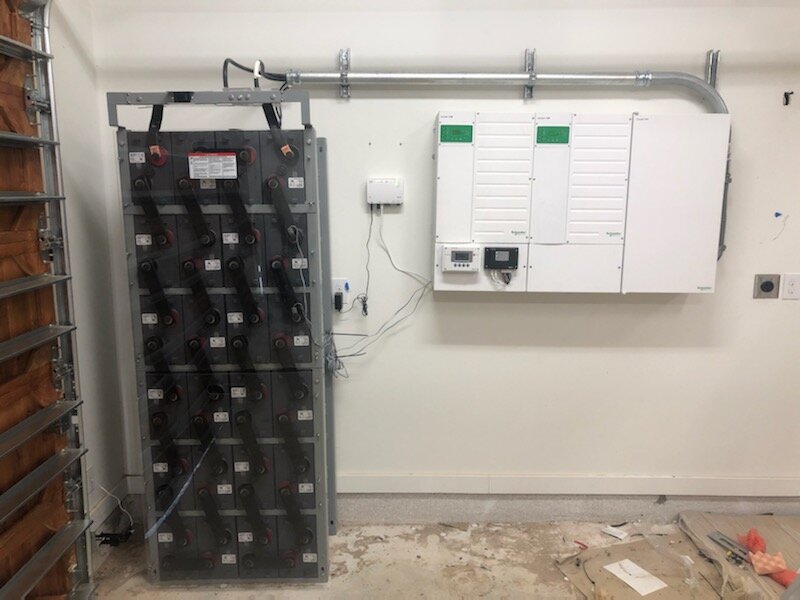
- Store power for overnight and cloudy-day use (battery bank)
- Convert that power to usable AC electricity for your home (inverter)
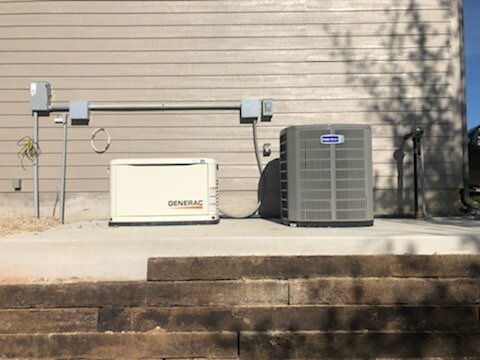
- Provide a backup source for extended low-sun periods (generator)
When sized correctly, the solar panels produce more energy than you use on most days. The excess charges your battery bank. At night and through cloudy stretches, the batteries supply your home. During longer periods of bad weather or unusually high usage, a backup generator (typically propane or diesel) kicks in to recharge the batteries.
The art of off-grid system design is sizing each of those four components correctly for your specific property, climate, and usage pattern. Undersize the solar and you’ll run the generator too much. Undersize the batteries and you’ll have nightly outages. Oversize either and you’ve spent money on capacity you don’t need.
System Components
The equipment we use for off-grid installs is generally heavier-duty than grid-tied gear because it has to operate reliably without backup from a utility:
Solar panels: Tier-1 monocrystalline panels with 25-year performance warranties. Off-grid arrays are often ground-mounted on rural properties where roof space is limited or angles are wrong — we design for whatever site conditions you have.
Battery storage: EG4, Sol-Ark, Tesla Powerwall, and Enphase IQ Battery systems available, depending on system size and configuration. Off-grid systems typically need substantially more battery capacity than grid-tied backup setups — sometimes 3-5x more — to handle multi-day stretches of low production.
Inverter / charge controller: Off-grid inverters do more than convert DC to AC — they also manage battery charging, generator coordination, and load priority. We use Sol-Ark hybrid inverters for most of our off-grid installs because of their flexibility and reliability.
Backup generator: Most off-grid systems include a propane or diesel generator that kicks in automatically when batteries get below a configurable threshold. Sized to recharge the battery bank in extended bad weather without becoming the primary power source.
Monitoring: Real-time and historical data on production, battery state of charge, generator runtime, and home usage — viewable from any device. Off-grid customers especially benefit from monitoring because there’s no utility safety net if something goes wrong.
Our Custom Off-Grid Design Process
Every off-grid system is custom. We don’t sell template systems because no two off-grid properties are the same. Here’s how the design process works:
1. Initial consultation. A 15-30 minute conversation to understand your property, your usage, your goals, and any utility connection alternatives you’ve explored. We’ll ask about your land, your buildings, your equipment, and how you intend to use the property.
2. Site visit. We come out to the property and survey the site — solar exposure, shading, terrain, available mounting locations (roof, ground, pole, awning), and existing electrical setup if any. For new construction, this often happens with your builder before framing.
3. Energy audit and load calculation. We work through your expected loads — every device, every system, when it runs, how often. For new construction, we work with your builder on intended appliances and HVAC. The output is a realistic energy budget the system has to meet.
4. System design. Based on the audit, we design the solar array, battery bank, inverter, and generator sizing. You get a detailed proposal showing system specifications, expected production, expected battery cycling, generator runtime estimates, and total cost.
5. Permitting and code compliance. Off-grid system permitting varies wildly across Texas counties — some require full electrical permits, others have minimal requirements for off-grid systems. We handle whatever your jurisdiction requires.
6. Installation. Our in-house crews handle the install. Off-grid installations typically take longer than grid-tied (more equipment, more wiring, often more remote sites), but our crews are experienced with off-grid work specifically.
7. Commissioning and customer training. Off-grid customers need to understand their system more than grid-tied customers do. We walk you through how the system works, how to monitor it, when to expect the generator to run, and what to do if something needs attention.
8. Ongoing support. We stay your point of contact for the life of the system — warranty service, monitoring questions, expansion planning if your needs grow.
Partnering with Custom Home Builders
For new construction projects, the best results come from integrating off-grid solar into the home’s design from day one rather than retrofitting it later. We partner with custom home builders across North Texas to make off-grid an option from the design phase forward.
Working together on a new build, we can:
- Specify electrical components (panel, breaker layout, conduit runs) to match the off-grid system
- Choose efficient appliances and HVAC that reduce required system size
- Plan optimal solar mounting locations (roof orientation, ground-mount areas, pole mounts)
- Size the battery storage room appropriately
- Coordinate generator placement, fuel supply, and ventilation
- Integrate monitoring systems with home automation
If you’re building and want to explore off-grid as an alternative to utility connection, get us involved early — ideally before final electrical and architectural plans are locked in.
Texas-Specific Considerations for Off-Grid Solar
A few things specific to Texas worth knowing:
Texas heat affects battery sizing. Battery capacity decreases at high temperatures, and Texas summers are brutal. We design battery banks with sufficient buffer for thermal performance loss in July and August. Battery storage location (ventilated indoor space vs. exposed outdoor enclosure) also factors into design.
Texas county permitting varies. Some rural Texas counties require minimal permitting for off-grid installations. Others require full electrical and structural permits. We work with your specific jurisdiction’s requirements.
ERCOT and the grid don’t enter the equation. One of the appeals of off-grid solar in Texas is being completely insulated from grid issues — Winter Storm Uri, summer heat-related outages, ERCOT reliability concerns. Off-grid customers don’t worry about any of it.
Property tax exemption applies. Texas exempts the added home value from solar installations from property taxes — including off-grid systems on residential property.
Insurance considerations differ. Off-grid systems on rural properties have different insurance considerations than urban grid-tied systems. We can discuss what to expect during your consultation.
Service Areas
We design and install off-grid solar systems across North Texas. Some of our most active service areas include:
- Weatherford Off-Grid Solar
- Dallas Off-Grid Solar
- Fort Worth Off-Grid Solar
- McKinney Off-Grid Solar
- Carrollton Off-Grid Solar
- Richardson Off-Grid Solar
- Garland Off-Grid Solar
- Prosper Off-Grid Solar
- Ennis Off-Grid Solar
- Clueburne Off-Grid Solar
- Greenville Off-Grid Solar
- Kaufman Off-Grid Solar
We serve many other cities across North Texas and beyond — particularly rural and ranch properties where utility connection isn’t practical. Contact us to confirm whether we can serve your location.
Frequently Asked Questions
Is going off-grid legal in Texas? Yes. Texas allows off-grid solar installations and there are no state-level restrictions on disconnecting from the grid. Local jurisdictions may have permitting requirements, but the practice itself is legal. We work with whatever permitting your county requires.
How much does an off-grid solar system cost? Off-grid systems range significantly in cost based on size, location, and complexity. A small cabin system might run $15,000-$25,000. A whole-home off-grid system for a ranch or custom build often runs $50,000-$150,000+ depending on capacity needs. We provide a detailed quote with full pricing transparency during your consultation.
Can I go partially off-grid? Technically yes — what’s usually called a “hybrid” or “grid-tied with backup” system. But true partial off-grid is less common because the system design is fundamentally different. If you want grid independence but still need grid access for peak demand, we’d recommend a grid-tied solar system with substantial battery backup rather than a partial off-grid setup. We can talk through both options during your consultation.
What happens during long stretches of bad weather? This is what the backup generator is for. Off-grid systems are designed with the assumption that some periods of low solar production will require generator backup. We size the generator and fuel storage to handle the longest realistic bad-weather stretch for your area — typically a few days, occasionally a week or more.
Do I need a generator with an off-grid system? For year-round occupied homes in Texas, yes. Even with substantial battery storage, multi-day cloudy/rainy stretches happen, and you need a backup source. For seasonal or vacation properties, you may be able to design around generator-free operation by accepting that the system goes dormant during extended bad weather and recharges before your next visit.
What batteries do you install for off-grid systems? We install EG4, Sol-Ark, Tesla Powerwall 3, and Enphase IQ Battery systems for off-grid applications, depending on system size and configuration needs. For larger off-grid systems with substantial capacity needs, EG4 and Sol-Ark are often the most cost-effective options. We discuss specific battery selection during your design phase.
Can I add to my off-grid system later? Yes, if the system is designed with expansion in mind. During the initial design phase, we can specify components that allow for adding panels, additional battery capacity, or additional loads later. Retrofitting expansion into a system that wasn’t designed for it is possible but generally more expensive than planning ahead.
Does the federal solar tax credit apply to off-grid systems? The federal Investment Tax Credit (ITC) has changed significantly in 2026. Individual homeowners can no longer claim the ITC directly for purchased solar systems. The credit is now available only to commercial buyers, who can pass the benefit through pre-paid leases or PPAs. We’ll discuss what options apply to your specific off-grid project during your consultation.
Does the Oncor Take A Load Off Texas program apply to off-grid systems? No. The Oncor Take A Load Off Texas program requires grid-tied systems. Off-grid systems aren’t eligible. If you’re considering grid-tied solar with battery backup instead of going fully off-grid, the Oncor program may apply.
How long does an off-grid solar installation take? Off-grid installations typically take 3-7 days on-site depending on system size and site complexity. The full timeline from signed contract to fully commissioned system varies widely — for new construction, it’s coordinated with the broader build schedule. For retrofit installations on existing buildings, it’s typically 4-8 weeks including permitting.
What kind of property is good for off-grid solar? Properties with good solar exposure (south-facing roof or ground area without heavy shading), enough land for ground-mounted arrays if roof space is limited, and either reasonable distance from utility infrastructure (so off-grid is cost-competitive) or a strong preference for energy independence. We’re glad to assess your specific property during a consultation.
Get a Free Off-Grid Solar Quote
If you’re considering off-grid solar for a custom home build, a ranch, a remote property, or any other Texas project — we’d be glad to help. Off-grid systems are our specialty, and we’ve been designing them for North Texas properties since 2015.
Call us at (940) 387-2716 or request a free quote online.