EV Charger Installation in Dallas-Fort Worth
On This Page
ToggleIf you’ve bought an electric vehicle — or you’re planning to — a properly installed home Level 2 charger transforms the experience. No more relying on public chargers or waiting overnight on a standard 120V outlet that adds 3-5 miles of range per hour. A home Level 2 charger fills your car’s battery 5-10x faster while you sleep.
North Texas Solar installs residential and commercial EV charging stations across the Dallas-Fort Worth area. We install Tesla Wall Connector, Enphase EV Charging Station, Wallbox, and other major chargers — including solar-integrated configurations that pair your EV with your existing solar system. Need an EV charger installed? Request a free quote or call us at (940) 387-2716.
Why Install a Home EV Charger
If you own an EV and you’re charging on a standard 120V outlet, you’re losing out on the experience EV ownership is supposed to deliver. Here are some specific reasons homeowners upgrade to a proper Level 2 charger:
Speed. A 120V (Level 1) outlet adds 3-5 miles of range per hour. A 240V Level 2 charger adds 25-45 miles per hour depending on amperage. For most homeowners, this is the difference between waking up to a full battery vs an empty one.
Convenience. Plug in when you get home, fully charged by morning. No need to manage charging schedules or worry about whether your car has enough range for tomorrow’s trip.
Cost. Home charging is dramatically cheaper than public DC fast charging or supercharging. The cost difference adds up to hundreds or thousands of dollars per year for the typical EV driver.
Less wear on the battery. Slower Level 2 charging is gentler on EV batteries than fast DC charging. Routine use of Level 2 at home extends battery life vs. frequent supercharging.
Solar integration. If you have solar on your home, an EV charger lets you essentially fuel your car for free during peak production hours. This combo is one of the biggest economic wins for solar-plus-EV households.

EV Chargers We Install
We install the major brands EV owners actually want. Each has strengths and tradeoffs.
Tesla Wall Connector
Tesla’s first-party charger, designed for Tesla vehicles but compatible with other EVs that use the NACS connector (and via adapter with J1772 cars).
Specs:
- Up to 48 amps / 11.5 kW output
- Hardwired or with 14-50 outlet
- Tesla app integration for monitoring and access control
- Internal load management for multi-charger setups
- Sleek aesthetic, popular for visible installations
Best for: Tesla owners who want full integration with the Tesla app and ecosystem. Also works well for non-Tesla EVs in a Tesla-future household.
Enphase EV Charging Station
Built by Enphase, designed to integrate with Enphase solar systems and the Enphase IQ Battery storage system.
Specs:
- 40-48 amp configurations
- Universal J1772 connector (works with all EVs except Tesla without adapter)
- Deep integration with Enphase monitoring app
- Smart charging coordination with solar production and battery state
Best for: Homeowners with existing Enphase solar systems who want unified monitoring and intelligent charge coordination.
Wallbox
Premium third-party charger known for smart features, app integration, and broad EV compatibility.
Specs:
- Multiple models (Pulsar Plus is popular for residential)
- Up to 40-48 amps depending on model
- Wi-Fi enabled with comprehensive app control
- Works with all J1772 and NACS EVs (with adapter for cross-compatibility)
- Some models support solar PV integration
Best for: Homeowners who want smart features, multi-EV households with mixed vehicle brands, or anyone who doesn’t want to be locked into a manufacturer’s ecosystem.
Other Brands
We’re glad to install other major chargers you’ve already purchased. ChargePoint, Grizzl-E, JuiceBox, and others all share the same basic electrical requirements — what changes is the unit itself, not the installation work.
Integrating EV Charging with Solar
If you have solar (or plan to), an integrated EV charging setup is one of the most powerful financial and practical decisions you can make.
The basic idea: When the sun is shining, your panels produce electricity. If your EV is parked at home, that electricity can charge your car instead of (or in addition to) running your home. The result: you’re essentially fueling your car with sunlight at zero marginal cost.
Typical configurations we install:
Grid-tied solar + EV charger (no battery). Your solar production reduces what you draw from the grid for everyday usage, including EV charging. Excess production exports to the grid (with REP-dependent buyback compensation). EV charging happens whenever you plug in, drawing from solar when available and grid when not.
Solar + battery + EV charger. Adds battery storage to time-shift solar production. You can charge your EV from stored solar even at night, or use grid-charged battery storage during peak demand hours (especially powerful with free nights plans — learn more in our buyback guide).
Smart-coordinated charging. If you have an Enphase system, the EV charger can communicate with your solar and battery to optimize charging — prioritizing solar production when available, deferring charging during low-production periods, charging from grid during off-peak hours.
The Texas-specific advantage: With Texas’s deregulated electricity market, you can pair solar + EV charging with the right Retail Electric Provider (REP) plan to dramatically reduce your effective fuel cost. Free nights plans, low-rate solar buyback plans, and time-of-use plans each interact differently with EV charging.
Commercial EV Charging Installations
We install commercial EV charging for businesses, multi-family properties, and any organization that wants to provide EV charging for customers, employees, tenants, or fleet vehicles.
Common commercial EV charging customers we serve:
Retail and restaurants. EV chargers in your parking lot attract EV-driving customers, increase visit duration (charging takes time), and signal modern values. Many small businesses install 2-4 charging stations in prime parking spots.
Office buildings. Workplace charging is increasingly an employee benefit expectation, especially for higher-skill positions. Installing 4-12 stations covers most office needs.
Multi-family properties. Apartment complexes, townhomes, and condos installing shared chargers for residents. Often combined with assigned parking and access control.
Auto dealerships. Increasingly required for EV brand dealerships. Installation needs to handle multiple vehicle types and charging speeds.
Fleet operations. Companies with delivery vehicles, service trucks, or company cars going electric. Often higher-amperage installations with specific dwell time requirements.
For commercial installations, we coordinate higher-amperage electrical service, often work with the property’s electrical panel and transformer setup, handle ADA-compliant installation requirements, and provide ongoing service for the equipment.
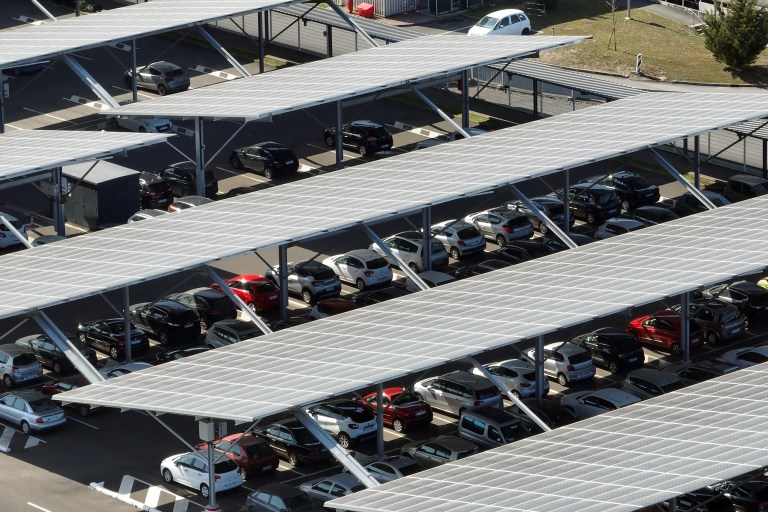
Solar Carports — Power and Shade Combined
For commercial properties (and occasionally large residential properties), solar carports combine solar generation with covered parking and EV charging in one structure. They’re a multi-purpose investment with several distinct benefits:
Generate solar power while providing covered parking — making productive use of otherwise-wasted parking lot real estate.
Provide shade during Texas summers — a parking lot full of shaded spots is a meaningful customer benefit when it’s 100°F+ outside.
Reduce business operating costs through solar generation offsetting your commercial electricity usage.
Integrate EV charging directly into the structure — chargers built into the carport columns or wired through the structure for clean, professional installations.
Attract EV-driving customers — modern, environmentally-conscious customers look for businesses that share their values. A solar carport with EV charging is a visible commitment.
Potential incentive eligibility including commercial Investment Tax Credit (ITC) and federal Modified Accelerated Cost Recovery System (MACRS) depreciation. Learn more in our commercial solar guide.
Solar carport projects are more complex than rooftop solar — they require structural engineering, foundation work, and often more involved permitting. We design and build them in partnership with structural engineers and concrete contractors.
Our EV Charger Installation Process
From your first call through final commissioning:
Initial Consultation
A brief call to understand your situation — your EV (current or planned), your electrical panel setup, where you want the charger installed, and your goals.
Site survey
We come to your home or business to verify the electrical panel capacity, the proposed charger location, the conduit/wiring run needed, and any installation considerations. For simple residential installations, this can sometimes be done remotely by submitting a few photos.
Quote
Itemized proposal showing the charger, electrical work, mounting hardware, permits, and labor.
Permit
Most DFW cities require electrical permits for EV charger installations. We pull permits as part of our process.
Installation
Most residential EV charger installations take 4-8 hours of on-site work. Complex installations or commercial projects take longer.
Commissioning
We energize the circuit, test the charger, walk you through any app setup, and verify everything works correctly.
Inspection
City electrical inspector signs off on the installation (you don’t need to be present for this).
For most residential installations, the entire process from first call to working charger takes 1-3 weeks depending on permit turnaround and our current scheduling.
EV Charger Installation Cost in DFW
Pricing varies based on the complexity of the installation. Here’s what to expect:
Charger unit cost: The charger itself typically runs $400-$1,500 depending on brand and features. Tesla Wall Connector and Wallbox Pulsar Plus are in the $500-$800 range. Enphase EV Charging Station is similar. Higher-end smart chargers can run $1,000-$1,500.
Installation cost ranges:
- Simple installation ($800-$1,500): Charger location near existing electrical panel, short conduit run, sufficient panel capacity, indoor garage location with easy access.
- Standard installation ($1,500-$3,000): New 240V circuit run, moderate conduit distance, some drywall or trim work, possibly exterior installation.
- Complex installation ($3,000-$6,000+): Long conduit runs (over 50 feet), electrical panel upgrade needed, multi-charger installations, exterior conduit work, or unusual configurations.
Factors that move the price:
- Distance from electrical panel to charger location
- Electrical panel capacity (older panels may need upgrades)
- Interior vs. exterior installation (exterior involves weatherproof conduit and connections)
- Conduit type and routing
- Single charger vs. multi-charger installations
- Wall vs. pedestal mounting
For commercial EV charging projects, costs are significantly higher due to scale, ADA compliance, possible utility transformer work, and higher-amperage electrical requirements. Commercial quotes are project-specific.
Insurance considerations: Some homeowner insurance policies require notification when installing an EV charger; check with your insurer. Most policies cover installations without premium increases.
Service Areas Across DFW
We install EV chargers across the Dallas-Fort Worth Metroplex, including Fort Worth, Dallas, Plano, Frisco, McKinney, Allen, Celina, Prosper, Mansfield, Richardson, Garland, Carrollton, Denton, Arlington, Keller, Southlake, Grapevine, Lewisville, Irving, Bedford, Hurst, Euless, Colleyville, Flower Mound, Highland Village, Wylie, Bowie, Decatur, Argyle, Justin, Roanoke, Melissa, Little Elm, and surrounding cities. Contact us to confirm service in your area.
Frequently Asked Questions
How long does it take to install an EV charger?
Most residential EV charger installations take 4-8 hours of on-site work. The full process from initial consultation to working charger is typically 1-3 weeks, including permits and scheduling. Complex installations or commercial projects take longer.
Do I need a special electrical outlet for a Level 2 EV charger?
You need a 240V circuit, typically 40-50 amps for residential Level 2 charging. Most EV chargers can be either hardwired or use a NEMA 14-50 outlet. Hardwiring is more reliable for high-amperage chargers; outlets allow flexibility if you replace the charger later.
How fast does a Level 2 charger charge an EV?
Most home Level 2 chargers add 25-45 miles of range per hour depending on the amperage. For most EVs, this means a fully empty battery charges overnight. Compare to 3-5 miles per hour on a standard 120V outlet.
Can my electrical panel handle an EV charger?
Most modern 200-amp panels can handle a Level 2 EV charger. Older 100-amp panels or homes with heavy electrical loads (electric heat, electric water heater, hot tub, pool equipment, etc.) may need panel upgrades. We verify panel capacity during the site survey. Learn more about our electrical services.
Will a home EV charger work with any electric vehicle?
Most Level 2 chargers use the J1772 connector that works with all EVs except Tesla (which uses its proprietary NACS connector). Tesla vehicles come with a J1772 adapter, so a non-Tesla charger works for them. Tesla Wall Connector uses NACS but works with non-Tesla EVs via an adapter. Increasingly, new EVs are adopting NACS as the universal standard.
Should I get a Tesla Wall Connector if I don't have a Tesla?
Possibly. The Tesla Wall Connector can work with non-Tesla EVs via a NACS-to-J1772 adapter (which Tesla sells). For mixed-brand households or homes likely to have a Tesla eventually, the Wall Connector is a good universal choice. For purely non-Tesla households, the Enphase or Wallbox chargers are simpler.
Can my EV charger be installed outside?
Yes. All major EV chargers are rated for outdoor installation. Exterior installations require weatherproof conduit, weatherproof connections, and sometimes additional considerations for sun exposure and physical protection. We handle exterior installations regularly.
Does my EV charger work with solar?
Yes — any Level 2 charger can be powered by your solar system since the electricity is just regular AC current at that point. For smart coordination (solar production prioritizing the EV automatically), the Enphase EV Charging Station integrates most deeply with Enphase solar systems. Wallbox models with PV integration also coordinate automatically. Tesla Wall Connector works with solar but doesn’t have explicit solar-coordination features.
Are there incentives for EV charger installation?
Possibly. The federal Alternative Fuel Vehicle Refueling Property Credit (a 30% tax credit) may apply to residential EV charger installations in certain census tracts (specifically, eligible non-urban or low-income communities). Some Texas utilities also offer EV charging incentives. We help you identify what applies during your consultation.
What's the difference between a Level 1, Level 2, and Level 3 charger?
Level 1 (120V) is the standard plug that came with your EV — slowest charging, 3-5 miles/hour. Level 2 (240V) is what we install at homes — much faster, 25-45 miles/hour. Level 3 (DC fast charging) is what you find at public supercharging stations — fastest, but not practical for home use due to electrical requirements and cost.
How much does a commercial EV charging installation cost?
Commercial projects vary widely based on the number of chargers, electrical infrastructure required, ADA compliance, parking lot configuration, and any utility-side work needed. Typical commercial projects range from $5,000-$10,000 per charger for simple multi-station installations to $50,000+ for larger projects with significant electrical upgrades.
Do you do solar carport installations?
Yes. We design and build solar carports for commercial properties (and occasionally large residential properties). These are more complex than rooftop solar because they require structural engineering and foundation work. Project costs vary widely based on size and configuration.
Get a Free EV Charger Installation Quote
If you’re considering an EV charger for your home or business in Dallas-Fort Worth, we’d be glad to help. The consultation is free, the site survey gives you a clear picture of what’s involved, and we provide itemized quotes so you know exactly what you’re paying for.
Call us at (940) 387-2716 or request a free quote online.
We’re a locally-owned solar installer and electrical contractor based in Fort Worth, serving Dallas-Fort Worth since 2015. Tesla Certified Installer, Good Contractors List member, BBB-accredited. Master electricians on staff for all electrical work.